Proxmox v9 Cluster Installation in VirtualBox
Installation of Proxmox v9 Cluster within VirtualBox for testing and learning
- Overview
- Setting up the Proxmox Nodes
- Building the Cluster
- Proxmox VE 9 & Debian 13 Air-Gapped Update Guide
Overview
This documenation describes a real-world virtualization lab by running Proxmox VE inside a VirtualBox VM, enabling a fully local environment for learning DevOps, infrastructure engineering, virtualization, and cloud concepts.
Proxmox & clustering — why it matters
Proxmox VE is a Debian-based, open-source hypervisor that runs KVM virtual machines and LXC containers, all managed through a web UI.
Benefits of clustering
- Single control plane: manage multiple Proxmox nodes from one dashboard.
- Live migration: move VMs between nodes with minimal downtime.
- High availability (HA): automatically restart VMs on healthy nodes if a node fails.
- Replication: scheduled syncing of VM data across nodes for fast recovery.
- Scalability: add nodes to increase capacity without reorganizing your setup.
- Better resource utilization: distribute CPU, memory, and storage load across the cluster.
When to use it
- Learning DevOps, infrastructure, or cloud concepts.
- Testing HA, migration, and replication workflows.
- Running multi-node labs that mirror production operations.
Key trade-offs
- Network and storage design become more important (latency, bandwidth, shared storage).
- Cluster management adds operational complexity and requires monitoring.
- Some features (e.g., HA, efficient replication) need reliable networking and proper fencing/qpinger setup.
Quick checklist to get started
- Ensure time sync (NTP) and reliable networking between nodes.
- Use separate networks for management, replication (migration), and cluster communication.
- Configure fencing/qdevice or quorum helpers for safety in failure scenarios.
- Test live migration and replication in your lab before trusting production workloads.
Key components
- Three computers or VMs with at least 6 GB RAM and 100 GB storage space per machine
- Storage can be lower as we will be using dynamically allocated virtual disks
- VirtualBox — host hypervisor that runs the Proxmox VM
- Proxmox VE ISO — installed as the nested hypervisor inside VirtualBox
- Ubuntu Server ISO — guest OS installed in a VM managed by Proxmox
- Debian Server ISO — guest OS install in a VM managed by Proxmox
- VBoxManage — CLI for creating and configuring the outer VirtualBox VM
- Proxmox Web UI — dashboard used to manage the inner guest VMs
2-Nods vs 3-Node Cluster
A 2-node cluster is simpler to set up and fine for learning, but it lacks a proper quorum (the voting system that keeps a cluster running when a node fails). That means HA isn’t reliable without extra workarounds to prevent the cluster from stalling.
A 3-node cluster includes quorum by default: two of three nodes can keep the cluster running if one goes down. It’s more stable, supports real HA testing, and scales better—though it requires one more machine and a bit more setup.
We’ll use a 3-node cluster because it’s the best balance of stability and realistic, hands-on experience.
Lab architecture (my current setup)
- AMD Ryzen 7 7800X3D
- 32 GB RAM
- 1 TB NVMe storage
Overview of what will be built
- Server Template inside VirtualBox to clone
- Installation Proxmox VE inside a VirtualBox VM clones
- Configured networking so the Proxmox Web UI is reachable from the host browser.
- Uploaded the Ubuntu Server ISO into Proxmox and created a guest VM.
- Launched and installed Ubuntu inside Proxmox.
- Resolved nested-virtualization KVM errors by disabling KVM for the guest.
Network configuration
- Adapter 1: Bridge — outbound internet access and management network.
- Adapter 2: Host-Only — host ↔ Proxmox cluster communication (coresync) network.
- Adapter 3: Host-Only — host ↔ Proxmox replication (migration) network.
I have choosen the following IP-Addresses for management, coresync and replication:
- Node 1:
- nic0
192.168.0.201(hostnameprox01.local) - nic1
172.20.1.201 - nic2
172.20.2.201
- nic0
- Node 2:
- nic0
192.168.0.202(hostnameprox02.local) - nic1
172.20.1.201 - nic2
172.20.2.201
- nic0
- Node 3:
- nic0
192.168.0.203(hostnameprox03.local) - nic1
172.20.1.201 - nic2
172.20.2.201
- nic0
You should adapt the IP address of nic0 (the main interface of the Proxmox node) so that it is in the same subnet as your PC (for example, both in 192.168.0.0/24). This allows direct communication without additional configuration. If they are in different subnets, a router with the correct routing rules is required — otherwise, your PC will not be able to reach the Proxmox node.
Once you have downloaded all the ISO images, continue on the next page with the installation and setup of the Proxmox nodes and networking.
Setting up the Proxmox Nodes
On the first page of this chapter, we defined our requirements and made some key decisions. Now, let’s set up the Proxmox nodes in VirtualBox and install Proxmox VE on them.

To ensure cluster stability and prevent traffic saturation, your test environment requires a minimum of three separate network interfaces:
- Management Interface: For host access and configuration.
- Cluster Communication (Heartbeat): Isolated traffic for node health and HA voting.
- VM Migration & Storage Replication: High-bandwidth link for data synchronization.
Note: While dedicating a network segment for NAS storage is a best practice in production, it is excluded from the scope of this virtualized test exercise.
Creating the Master Virtual Machine (Hardware Mode)
To avoid missing critical settings or having to restart the process, it is recommended to build a single VirtualBox Virtual Machine (VBVM) to act as a template. You can name this master image proxtpl so that it remains at the bottom of your VM list. Ensure that you never actually start the master image; it must remain powered off.
- Name:
proxtpl - Type: Linux, Debian (64-bit)
- RAM: 2 GB minimum (4 GB or 6 GB is recommended if your host hardware allows).
- Storage (SATA0): Create a 32 GB boot drive for the Proxmox installation.
- Storage (SATA1 & SATA2): Create two 32 GB dynamically allocated disks; these will be used for the ZFS storage pool. You may use 64 GB if you have sufficient space.
- Boot Order: Adjust the order to set Hard Disk first and Optical second.
- Optical Drive: Mount the Proxmox ISO.
- Network Adapters: Attach 3 adapters:
- nic0: BRIDGED (Management interface)
- nic1: HOST-ONLY (Cluster interface / Core sync) — Disable DHCP
- nic2: HOST-ONLY (Replication / Migration interface) — Disable DHCP
Once configured, your setup should look like this:
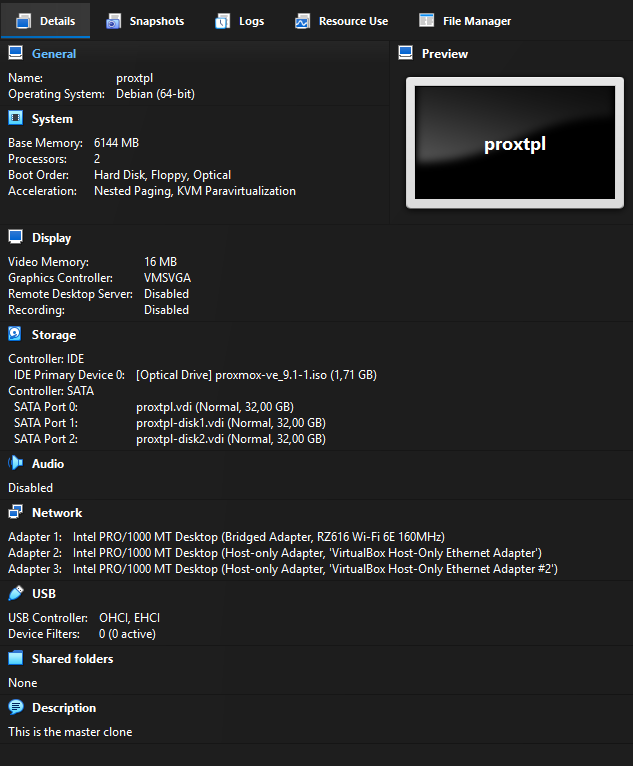
Once the master is configured, create three clones and name them prox01, prox02, and prox03.
Installing Proxmox VE (Software Mode)
With your three clones created, start them up to begin the installation.
- Ignore KVM Virtualization errors: You will likely see an error stating that KVM Virtualization is not detected. This is expected, as VirtualBox may not pass VT-x/AMD-V instructions through to the guest. This is not an issue for this lab, as the test cluster will run Linux Containers (LXC) instead of full VMs.
- Verify hostnames: Ensure you correctly name each node (e.g.,
prox01.local,prox02.local,prox03.local) during setup. Renaming a node after a cluster is established is a complex and difficult procedure. - Select the 32GB boot drive for the installation target.
- Configure sequential IP addresses: Base these on the hostnames to simplify management (e.g.,
prox01– 192.168.10.201,prox02– 192.168.10.202,prox03– 192.168.10.203). - Network Settings: Set the Netmask to
255.255.255.0or use CIDR notation (e.g.,192.168.10.201/24). - Gateway: Set this to your network's gateway, most likely
192.168.10.1. - DNS Server: Set this to your local DNS configuration, also likely
192.168.10.1. - Finalize: After installation, shut down the hosts and reboot them in headless mode. This is where the boot order change from earlier comes in handy.
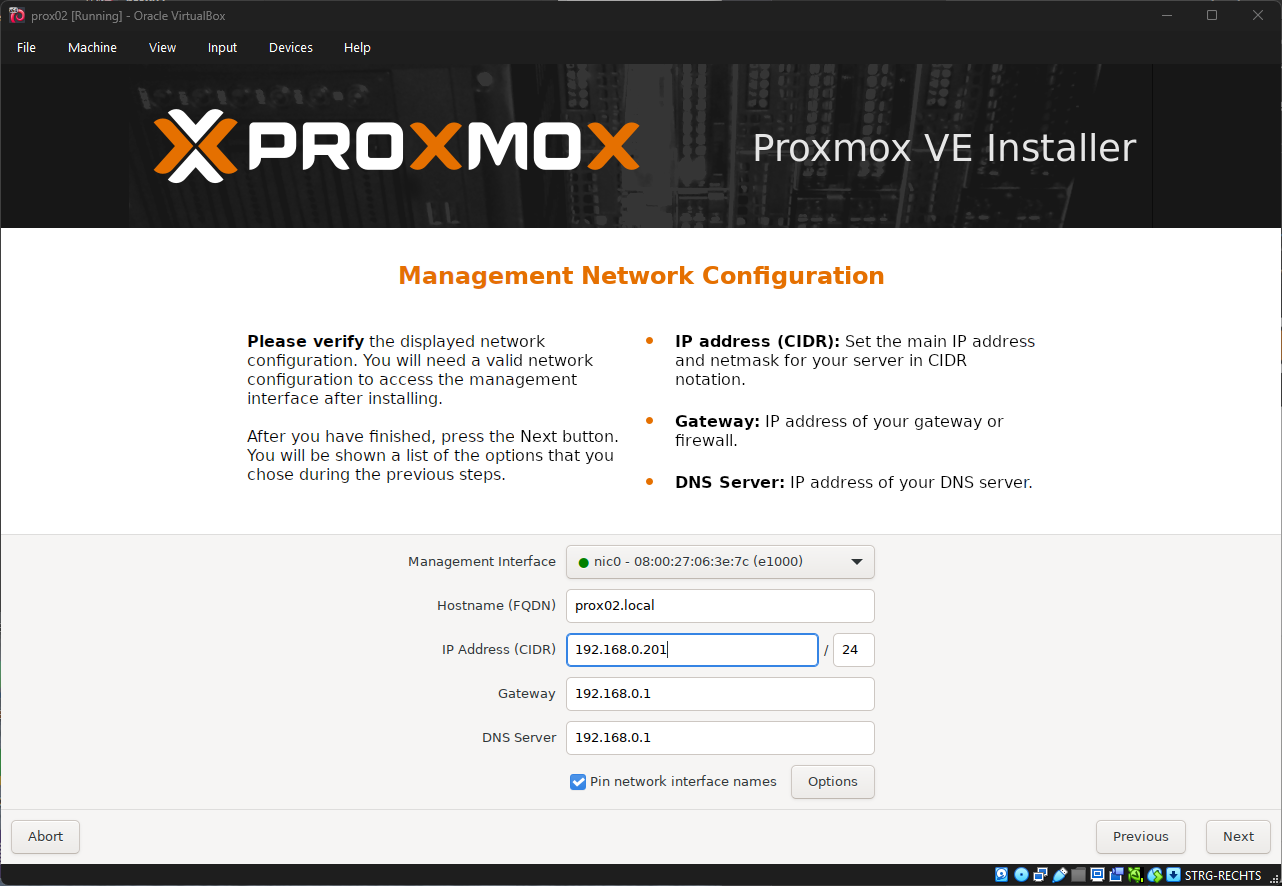
Unfold to see predefined IP Configuration
Remember the IP Configuration from the Overview-Page:
- Node 1:
- nic0
192.168.0.201(hostnameprox01.local) - nic1
172.20.1.201 - nic2
172.20.2.201
- nic0
- Node 2:
- nic0
192.168.0.202(hostnameprox02.local) - nic1
172.20.1.201 - nic2
172.20.2.201
- nic0
- Node 3:
- nic0
192.168.0.203(hostnameprox03.local) - nic1
172.20.1.201 - nic2
172.20.2.201
- nic0
After the reboot, access the web interface on port 8006 (HTTPS). You will likely be prompted to accept a self-signed certificate. Once you accept the security risk, you should see the Proxmox dashboard.
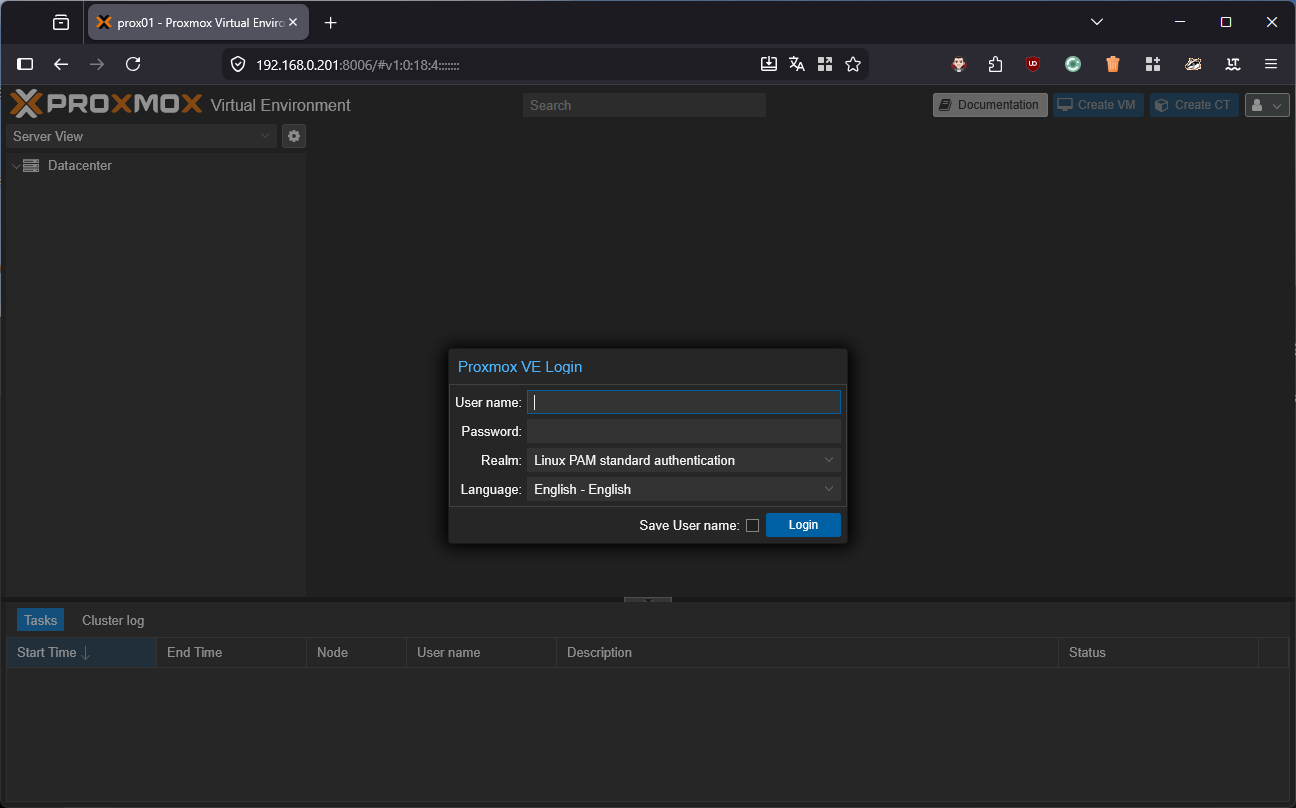
Post-Installation
Once your Proxmox nodes have successfully booted, there are several essential post-installation tasks to complete, such as managing repositories and removing subscription warnings. The most efficient way to handle this is by using the Proxmox VE Community Post-Install Script. This interactive script automates the removal of the "No Valid Subscription" nag-screen, configures the correct non-subscription repositories, and optimizes system settings.
bash -c "$(curl -fsSL https://raw.githubusercontent.com/community-scripts/ProxmoxVE/main/tools/pve/post-pve-install.sh)"These are my recommended choices:
- disable pve-enterprise repository
- disable ceph enterprise repository
- enable/keep pve-no-subscription repository
- select NO to the pve-test repository
- select YES to disable the subscription nag
- select NO when asked to disable high availability
- select NO when asked to update (we will set up the ZFS Storage first)
- select NO when asked to reboot (we will set up the ZFS Storage first)
Install on an Air-Gapped environment
For an air-gapped (offline) environment, the standard script cannot reach external Proxmox servers. To resolve this, you can host a local version of the script within your network.
1. Host the Script Locally
Download the script to a machine that has network access to your Proxmox nodes. Navigate to the folder containing the script and start a temporary web server using Python:
# Start a local web server on port 8000
python3 -m http.server 8000
2. Execute on the Proxmox Node
Log into your Proxmox node's console and run the following command to pull and execute the script from your local server.
Note: Replace
192.168.0.20with the actual IP address of the machine running the Python server.
bash -c "$(curl -L http://192.168.0.10:8000/post-pve-install.sh)"This method allows you to maintain a consistent configuration across all nodes in your cluster without requiring direct internet access for each individual machine.
Setting up ZFS Storage
Updating and final reboot
About the Network Interface Design
A successful Proxmox cluster requires careful network segregation to prevent traffic saturation. At a minimum, you will need three separate network interfaces for your VirtualBox test cluster:
- Management Interface: This connects to your internal network and serves as the primary way to access and manage the Proxmox hosts.
- Cluster Communication Heartbeat: This interface acts as the lifeline for the Proxmox hosts to communicate. It must be placed on its own isolated network segment (or physically isolated switch) because constant cluster "chatter" and High Availability (HA) voting can easily overwhelm a shared network link.
- VM Migration & Storage Replication: A dedicated interface is needed for migrating machines and handling Storage Replication, which copies data across nodes every 15 minutes. Combining this heavy file synchronization traffic with standard cluster communication can quickly saturate a single network connection, potentially leading to false-positive node failures.
Building the Cluster
Setting IP ADdress
I did my best to simplify the network design:
There are 3 PVE hosts with corresponding management IP’s:
- prox1 – 192.168.0.201
- prox2 – 192.168.0.202
- prox3 – 192.168.0.203
Each PVE host has 3 network adapters:
- Adapter 1: A Bridged Adapter that connects to the [physical] internal network.
- Adapter 2: Host only Adapter #2 that will serve as the [virtual] isolated cluster network.
- Adapter 3: Host only Adapter #3 that will serve as the [virtual] dedicated migration network.
Each network adapter plugs into a different [virtual] network segment with a different ip range:
- Adapter 1 (vmbr0) (nic0) – 192.168.0.0/24
- Adapter 2 (nic1) – 192.168.101.0/24
- Adapter 3 (nic2) – 192.168.102.0/24
Each PVE hosts’ IP on each network roughly corresponds to its hostname:
- prox1 – 192.168.0.201, 192.168.101.1, 192.168.102.1
- prox2 – 192.168.0.202, 192.168.101.2, 192.168.102.2
- rox3 – 192.168.0.203, 192.168.101.3, 192.168.102.3
Prox 1 Example
auto lo
iface lo inet loopback

iface nic0 inet manual

auto vmbr0
iface vmbr0 inet static
        address 192.168.0.201/24
        gateway 192.168.0.1
        bridge-ports nic0
        bridge-stp off
        bridge-fd 0

# cluster network
auto nic1
iface nic1 inet manual
        address 192.168.101.1/24

# migration network
auto nic2
iface nic2 inet manual
        address 192.168.102.1/24

source /etc/network/interfaces.d/*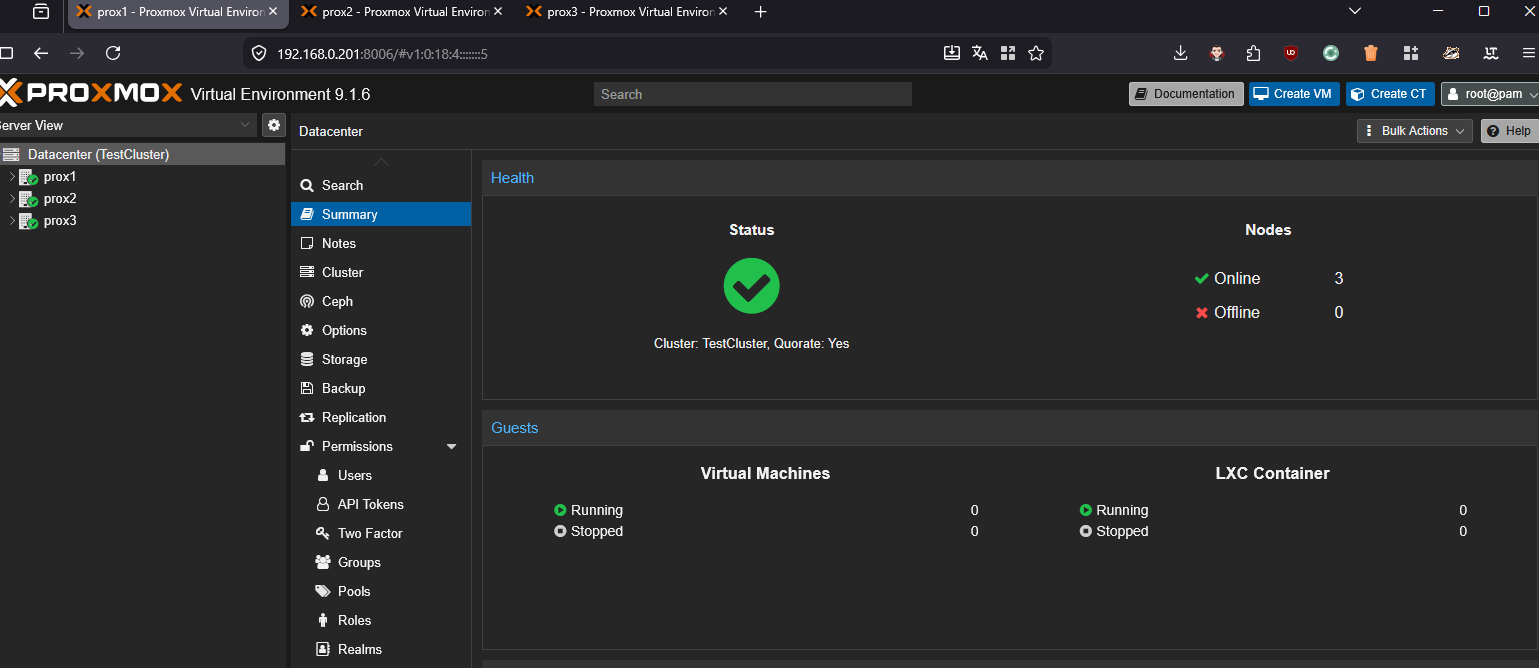
Proxmox VE 9 & Debian 13 Air-Gapped Update Guide
This guide describes how to set up an intermediate APT cache on an internet-connected machine (via VirtualBox) and transfer that cache to an air-gapped environment to update Proxmox VE 9 installations.
Phase 1: VirtualBox Setup (Internet-Facing Host)
On your internet-connected machine, you need two virtual entities: the Cache Server and a Template Proxmox VM to "pull" the initial data.
1.1 Debian 13 (Trixie) Cache VM
- Create VM: 2 vCPUs, 2GB RAM, 50GB+ Disk (depending on how many packages you cache).
- Networking: Use Bridged Adapter to ensure it has its own IP on your local network.
- OS Installation: Install a minimal Debian 13 (Netinst). Ensure
SSH serverandStandard system utilitiesare selected.
I did set it up with the hostname prox-cache in my lan with the domain lan.zn80.net with the IP 192.168.0.240/24.
When you get asked what to install in addition to the basis system, deselct the Desktop Environment and select only WebServer, SSH Server and Standard System Utilities.
After starting the system, enable the sshd.service
systemctl enable sshd.service
systemctl start sshd.service
Also add a static IP address by editing the /etc/network/interfaces file:
# The primary network interface
allow-hotplug enp0s3
iface enp0s3 inet static
        address 192.168.0.240/24
        gateway 192.168.0.1
This should be it for now. Continue with installing the Proxmox-Feeder.
1.2 Proxmox VE 9 "Feeder" VM
To populate the cache, you need a machine that requests the specific Proxmox 9 packages.
- Create VM: 2 vCPUs, 4GB RAM, 20GB Disk.
- OS Installation: Install Proxmox VE 9 (or Debian 13 + PVE 9 packages).
- Networking: Ensure it can reach the Debian 13 Cache VM.
Id did set it up with the hostname prox-feeder in my lan with the domain lan.zn80.net with the IP 192.168.0.241/24.
After installing the proxmox feeder vm we need to configure the in the next steps. Do not update the initial installation yet.
Phase 2: Setting up APT-Cacher-NG (Cache Server)
Before installing the cache, we will optimize the Debian mirror selection to ensure the fastest download speeds.
2.1 Optimization: Selecting the Fastest Mirror
Install netselect-apt to automatically determine the best mirror for Debian 13.
# Install netselect-apt
sudo apt update
sudo apt install netselect-apt -y

# Find the fastest mirror for Debian 13 (Trixie)
# This creates a 'sources.list' file in the current directory
sudo netselect-apt trixie

# Backup existing sources and apply the new optimized list
sudo mv /etc/apt/sources.list /etc/apt/sources.list.bak
sudo mv sources.list /etc/apt/sources.list
sudo apt update
2.2 Install and Configure APT-Cacher-NG
Now, install the caching service which will use the fast mirrors selected above.
Installation
sudo apt install apt-cacher-ng -y
Configuration
Edit the configuration to ensure it allows Proxmox repositories:
sudo nano /etc/apt-cacher-ng/acng.conf
Ensure the following line is active to allow HTTPS tunneling if necessary:
PassThroughPattern: .*
Restart Service
sudo systemctl restart apt-cacher-ng
Phase 3: Populating the Cache
On your Proxmox VE 9 "Feeder" VM, tell APT to use the Cache Server.
- Create a proxy configuration file:
echo 'Acquire::http::Proxy "http://<IP-OF-CACHE-SERVER>:3142";' | sudo tee /etc/apt/apt.conf.d/00proxy
- Run the updates to pull data into the cache:
apt update
apt dist-upgrade -y
```
Now, all downloaded `.deb` files are stored on the Debian 13 Cache VM in `/var/cache/apt-cacher-ng`.
Phase 4: Exporting the Cache to the Air-Gapped System
Since the target system is air-gapped, we must physically move the data.
4.1 On the Internet-Connected Cache VM:
Compress the cache data:
sudo tar -cvzf pve-cache-export.tar.gz /var/cache/apt-cacher-ng
Copy pve-cache-export.tar.gz to a USB drive or mobile storage.
4.2 On the Air-Gapped Target System:
You need a machine (or LXC container) in the air-gapped network to act as the Local Cache Server.
- Install a Debian 13 LXC or VM on your air-gapped Proxmox.
- Install
apt-cacher-ng(you might need to install this manually via.debfiles once if the container isn't prepared). - Import the data:
# Extract the data to the correct location
sudo tar -xvzf /path/to/usb/pve-cache-export.tar.gz -C /
sudo chown -R apt-cacher-ng:apt-cacher-ng /var/cache/apt-cacher-ng
sudo systemctl restart apt-cacher-ng
Phase 5: Configuring Air-Gapped Proxmox Clients
Now, configure all your air-gapped Proxmox 9 nodes to use the internal cache server.
5.1 Set the Proxy
Edit /etc/apt/apt.conf.d/00proxy on every node:
```text
Acquire::http::Proxy "http://<INTERNAL-CACHE-LXC-IP>:3142";
```
5.2 Update Repository Sources
Ensure your /etc/apt/sources.list and /etc/apt/sources.list.d/pve-enterprise.list point to standard URLs. Even though there is no internet, apt-cacher-ng will trick APT into thinking it's talking to the real servers, while actually serving the files from the local disk.
Example for Proxmox 9 (No-Subscription):
deb [http://download.proxmox.com/debian/pve](http://download.proxmox.com/debian/pve) trixie pve-no-subscription
5.3 Run Update
apt update
apt dist-upgrade
Troubleshooting & Maintenance
- Maintenance: To update the air-gapped system again, repeat Phase 3 (on the internet host) and Phase 4 (transfer).
- Disk Space: Monitor
/var/cache/apt-cacher-ng. You can use the web interface athttp://<cache-ip>:3142/acng-report.htmlto manage the expiration of old packages.
Soll ich dir noch spezifische Konfigurationsparameter für die Proxmox Enterprise Repositories heraussuchen, falls du diese über den Cache spiegeln möchtest?